Choose an instrument
An instrument is the sound used by a Phrase note. Each Phrase row chooses an
instrument number such as I00; opening that number lets you choose and shape
the sound.
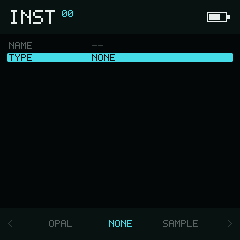
An empty instrument begins as NONE. Choose a Type to create its sound.
Try the built-in OPAL synth
- In Phrase, place the cursor on a row that uses
I00. - Hold Shift and press Right to open Instrument 00.
- Move Down once to Type.
- From
NONE, press Left once to chooseOPAL. - Hold Shift and press Left to return to Phrase.
- Hold Enter on the note to hear it.
OPAL and SID make sound without loading a file. A Sample instrument needs a WAV, and MIDI plays an external instrument.
Instrument types
| Type | Use it for |
|---|---|
SAMPLE | Play, loop, process, and slice a WAV |
MIDI | Play an external synth or software instrument |
SID | Make chip-style basses, leads, and noise |
OPAL | Make FM bells, basses, and additive tones |
NONE | Leave the instrument empty |
Moving around
| Input | Result |
|---|---|
| Up / Down | Move through Name, Type, and the parameter list. Long lists scroll with the cursor. |
| Left / Right | Change the selected action, type, selector, or value. Numeric fields use their fine step. |
| Hold Enter + Up / Down | Make the selected numeric value's coarse adjustment. On a multi-digit value, edit the focused digit. |
| Hold Enter + Left / Right | Make a fine adjustment, or move between digits/bits when the field exposes them. |
| Hold Option + Up / Down | Select the previous or next instrument slot. The list wraps between 00 and 3F. |
| Hold Option + Left / Right | Select track T1–T8 for phrase-context playback. |
| Hold Shift + Left | Return to Phrase. |
| Hold Shift + Down | Open the selected instrument's Table context. |
| Play | Control phrase-context playback for the selected track. |
Choice fields such as NO / YES, loop mode, waveform, and algorithm wrap around when changed. Ordinary numeric ranges clamp at their minimum and maximum.
Name actions
Move the cursor to Name, then use Left / Right to choose one of the three bottom-bar actions:
- Load opens the instrument browser. Choose an instrument file and press Enter to import it into the current slot. Stop playback first.
- Save exports the current instrument. Give it a name first; an empty
NONEinstrument cannot be saved. If the name exists, confirm whether to replace it. - Rename opens the on-screen keyboard for the current slot.
An exported Sample instrument stores its settings and sample filename; it does not bundle the WAV file. Copy the sample separately when moving the instrument to another device or project.
Changing type
Select Type and press Left / Right to cycle through:
NONE → SAMPLE → MIDI → SID → OPAL → NONE
If the current instrument has a name or edited settings, NullPerator asks before replacing it. Stop playback and note preview before changing type.
Editing fields
Most parameters change directly with Left / Right; holding Enter adds the vertical coarse-edit gesture shown in the bottom bar. Compound values behave differently:
- On a hexadecimal digit field, hold Enter, move Left / Right to choose a digit, then press Up / Down to edit it.
- On a bit field, hold Enter, choose a bit with Left / Right, then press Up / Down to toggle it.
- On an OPAL operator row, Left / Right without Enter switches between operator 1 and operator 2. Hold Enter while editing the operator value.
- On a Sample or MIDI
TABLEfield, press Enter to assign the first free table. This replaces the field's current table number.
Instrument changes are saved with the project. Save on the Instrument page creates a separate instrument file that you can import elsewhere.
See Limits and compatibility for the number of instruments available for each type.