GB-Wave, GB-Pulse, and GB-Noise
Choose GB-WAVE, GB-PULSE, or GB-NOISE in the Instrument Type row.
These are three independent synth types, not Stack modes. They need no sample
files and can occupy any of the 64 instrument slots, with different settings
in each slot.
Use GB-Pulse for duty-cycle leads, GB-Wave for a custom 4-bit waveform, and GB-Noise for percussion. Choose Chiptune instead when you want its broader waveform selection, noise burst, and built-in arpeggio-speed control, or Stack for chords and detuned layers.
Try a pulse lead
- Assign an instrument to a Phrase note and open that instrument.
- Change Type to
GB-PULSE. Keep DUTY at50%, ENVELOPE atF0, and LENGTH /256S at00. - Return to Phrase and play the note. It holds until replaced or stopped.
- Add
ARP 4700to cycle the base note, major third, and fifth. - Try
SIP 0001on a later step: the sounding voice changes to 25% duty. Triggering a new note restores the instrument's saved 50% duty.
All numeric values below are hexadecimal unless stated otherwise. On digit-editable fields, hold Enter, choose a digit with Left / Right, and adjust it with Up / Down.
Shared controls
| Field | Values | Default | Meaning |
|---|---|---|---|
VOLUME | 00–FF | 80 | Voice output gain, separate from the pulse/noise envelope or wave output level |
TRANSPOSE | −24 to +24, decimal | 0 | Semitone offset; Pulse and Wave only |
LENGTH /256S | Pulse/Noise 00–40; Wave 000–100 | 00 / 000 | Countdown in 1/256-second units; zero disables automatic length stopping |
TABLE | --, 00–1F | -- | Attached instrument Table |
AUTOMATION | NO, YES | NO | Uses the instrument-table automation mode |
For example, length 40 is 64/256 seconds (one quarter second), not 40
tracker ticks. Envelope, sweep, and length clocks are independent of song tempo.
Note Off and GOF stop a GB voice immediately; KIL uses its tracker-tick delay.
GB-Pulse
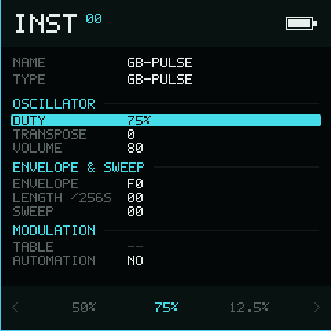
Pulse keeps duty, envelope, length, sweep, and Table controls in one instrument. This example changes duty from its default 50% to 75%.
| Field | Values | Default | Meaning |
|---|---|---|---|
DUTY | 12.5%, 25%, 50%, 75% | 50% | Four pulse patterns; SIP addresses them as 00–03 |
ENVELOPE | 00–FF | F0 | Initial level, direction, and automatic level-step period |
SWEEP | 00–7F | 00 | Pulse frequency-period sweep |
The envelope byte is VVVVDPPP in binary: V is the starting level 0–15,
D selects increase (1) or decrease (0), and P is the number of 1/64-second
intervals between level steps. P = 0 disables automatic steps. F0 holds the
maximum envelope level; F2 starts at maximum and decreases every 2/64 seconds.
Values 00–07 disable the pulse/noise DAC and produce no sound.
The sweep byte is 0PPPDSSS: P sets the sweep period in 1/128-second units,
D chooses subtraction (1) or addition (0) to the frequency period, and S
is the right-shift amount used to calculate the change. Zero period disables
periodic sweep. A sweep that overflows the supported period stops the voice.
Keep 00 while editing a steady lead.
GB-Wave
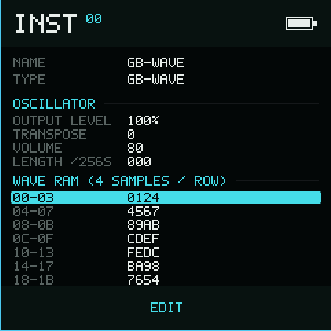
Each digit under Wave RAM is one sample. Here the fourth point has changed from 3 to 4; scroll down for the remaining wave and Table rows.
| Field | Values | Default | Meaning |
|---|---|---|---|
OUTPUT LEVEL | MUTE, 100%, 50%, 25% | 100% | Wave-sample bit shift; separate from VOLUME |
00-03 through 1C-1F | Four digits per row, each 0–F | See below | 32 waveform samples, four samples per row |
The default waveform is:
0123 4567 89AB CDEF FEDC BA98 7654 3210
Each digit is one 4-bit sample, not part of an ordinary 16-bit amplitude.
Editing 00-03 from 0123 to 012F changes only sample 03. The eight rows
form one repeating waveform. Wave data is saved inside the instrument.
There is no Pulse/Noise-style envelope or sweep field on GB-Wave. Use Table
VOL or SIP steps for level changes. OUTPUT LEVEL reduces sample precision
by bit shifting; VOLUME controls the subsequent voice gain.
GB-Noise
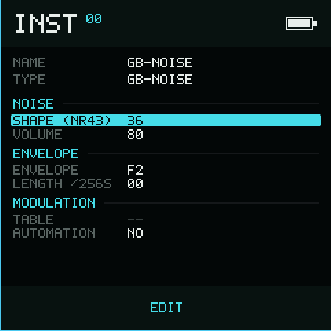
Noise shape changes the generator's clock and width. This example edits the default shape 35 to 36.
| Field | Values | Default | Meaning |
|---|---|---|---|
SHAPE (NR43) | 00–FF | 35 | Noise clock shift, register width, and divisor code |
ENVELOPE | 00–FF | F2 | Same encoding as GB-Pulse |
SHAPE (NR43) is SSSSWDDD in binary: S is the clock shift, W chooses
a 7-bit (1) or 15-bit (0) noise register, and D is the divisor code.
For example, 35 and 3D use the same shift/divisor with different widths.
Clock shifts E and F stop noise-clock advancement; choose a lower shift
for changing noise.
Notes trigger the sound but do not set its pitch. Change SHAPE (NR43) or
use SIP 00bb to alter the noise clock. There is no transpose control, and
ARP, LEG, PFT, PSL, and VIB do not affect GB-Noise.
Native effects
| Type | Instrument effects |
|---|---|
| GB-Pulse / GB-Wave | ARP, GOF, LEG, PAN, PFT, PSL, SIP, VIB, VOL |
| GB-Noise | GOF, PAN, SIP, VOL |
Common Phrase/Table commands such as DLY, KIL, TBL, and IRT remain
available in their respective contexts. GB types do not implement CSH,
RTG, or Stack chord commands. The command reference
lists page restrictions and parameter timing.
On GB types, VOL aabb applies bb immediately and ignores aa; it does
not use Chiptune's volume-ramp timing. Pulse/Wave ARP advances on tracker
ticks. Native PAN supports intermediate positions, not just hard left/right.
SIP parameter map
SIP aabb changes the sounding voice, not the saved instrument. A new note
restores the saved settings. Unlisted indices are ignored.
aa | GB-Pulse | GB-Wave | GB-Noise |
|---|---|---|---|
00 | Duty 00–03 | Output level 00–03 (mute/full/half/quarter) | Noise shape byte |
01 | Transpose, signed byte clamped to −24…+24 | Same | Ignored |
02 | Volume 00–FF | Same | Same |
03 | Length 00–40 | Length 00–FF | Length 00–40 |
04 | Envelope byte | Ignored | Envelope byte |
05 | Sweep 00–7F | Ignored | Ignored |
10–2F | Ignored | Wave sample 00–1F, value 00–0F | Ignored |
Wave's saved length can reach 100, but the one-byte SIP value reaches only
FF. SIP 100F sets the first waveform point to F; SIP 2F00 sets its last
point to 0. SIP 010C transposes Pulse or Wave up 12 semitones.
Voices and compatibility
GB instruments share eight track voices. A preset can play on several tracks; different GB presets can play on different tracks. A new note on the same track replaces its previous voice. The project is not constrained to a Game Boy's two-Pulse / one-Wave / one-Noise arrangement.
These synths implement GB-style period quantization, pulse patterns, wave RAM, noise registers, and frame-sequencer timing. They are not a full CPU/APU bus emulator: wave-RAM corruption, envelope zombie writes, and DIV-write quirks are not emulated. Native tracker effects are not LSDJ commands, and LSDJ-specific sequencing, wave synthesis, and kit playback are not supplied by these types. See LSDJ and other trackers before moving a project from another tracker.